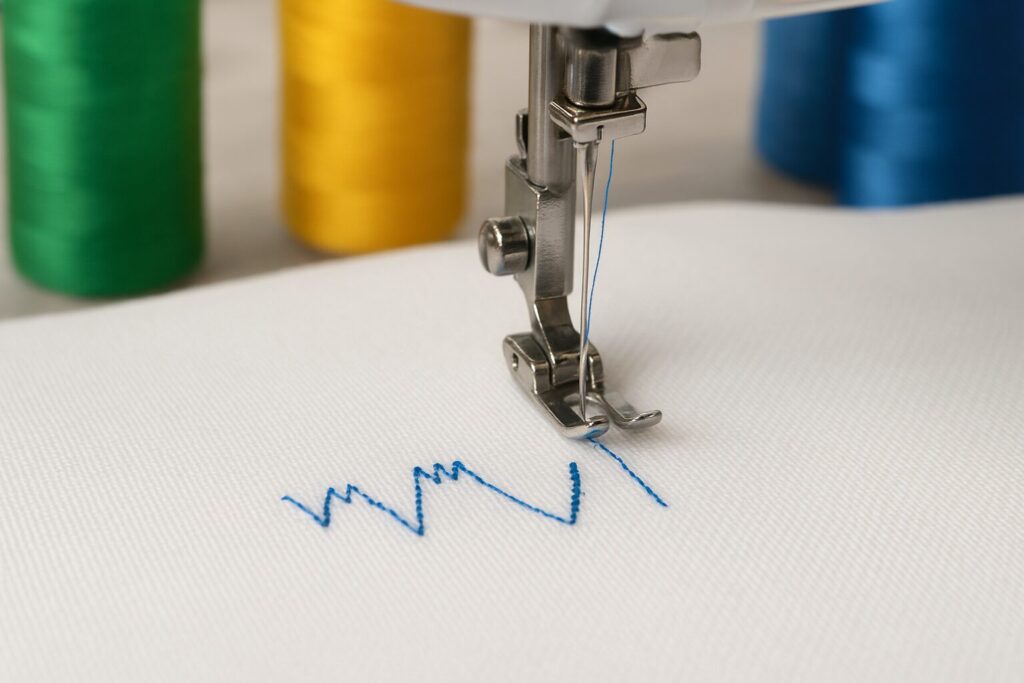
You are sewing a heavy leather holster or a canvas tote bag. The machine is humming along perfectly on the flat sections. The stitches are even, the tension is balanced, and the rhythm is hypnotic.
Then, you reach the “hump.” This is the spot where a strap crosses a seam, or where the welt meets the gusset. Suddenly, you are asking the needle to punch through four or five layers of material instead of two.
You slow down. You hold your breath. The needle goes down… and comes up. But the thread didn’t lock. You see a long, straight line of thread floating on top of the leather. A skipped stitch.
You try again. Another skip. Frustrated, you crank the handwheel manually, and crack—the needle breaks.
This is the most common and infuriating problem in heavy-duty sewing. It feels random, but it is actually a precise failure of physics known as “Needle Deflection.” Understanding why it happens is the key to stopping it.
Table of Contents
ToggleThe Geometry of the Loop
To understand a skipped stitch, you have to visualize what happens under the throat plate.
When the needle goes down into the material, it carries the top thread with it. When it starts to rise back up, the friction of the material holds the thread back slightly. This causes the thread to bow out, forming a small “loop” on the backside of the needle (the scarf).
The “hook” (the rotating metal point that circles the bobbin) is timed perfectly to pass by the needle at that exact millisecond. It grabs that loop, pulls it around the bobbin, and forms the lockstitch.
The tolerance for this hand-off is microscopic. The hook point passes within 0.05mm to 0.1mm of the needle. It is closer than a human hair.
The Deflection Factor
Now, introduce the “hump.”
When you sew through two layers of leather, the needle travels straight down. But when you hit a thick, dense stack—like 3/4-inch of veg-tan saddle skirting—the needle encounters massive resistance.
If the needle is even slightly flexible (which all metal is), or if the layers shift slightly as the foot presses down, the needle will bend. It deflects.
Usually, it deflects away from the hook.
So, when the hook comes around to grab the thread loop, the needle isn’t where it is supposed to be. It is bent 0.5mm to the left. The hook misses the loop entirely. The needle comes back up, and no knot is formed. That is a skipped stitch.
If the needle deflects the other way (towards the hook), it hits the metal hook point. This creates a burr on the hook (which shreds thread later) or shatters the needle instantly.
The “Needle Feed” Solution
Standard “drop feed” machines (like home sewing machines) are terrible at preventing this because the needle is passive. It just goes up and down while the feed dogs drag the material. The drag creates lateral pressure on the needle, encouraging it to bend.
Industrial machines designed for this work use a “Compound Feed” or “Unison Feed” system.
In this system, the needle moves with the material. It stabs into the leather, and then the entire needle bar moves backward while the needle is buried in the stack.
Because the needle is moving at the same speed as the material, there is zero lateral drag on the shaft. It enters straight, travels straight, and exits straight. This eliminates the bending force. The hook hits the loop every single time, even through inch-thick assemblies.
The Stiffness of the Shaft
The other factor is the needle itself.
In garment sewing, needles are thin (size 12 or 14) to avoid damaging delicate fabric. In heavy work, you need a girder.
Needles for these machines (often System 135×16 or 135×17) are designed with a much thicker shaft relative to the eye size. A Size 23 or 24 needle is essentially a nail. It is rigid enough to punch through plywood without flexing.
Using a needle that is too small for the thickness of the material is a guarantee of deflection. If you are sewing a gun belt, you cannot use a size 18 needle. It will behave like a wet noodle. You need the rigidity of a size 24 or 25 to maintain that 0.1mm tolerance with the hook.
Conclusion
Skipped stitches are not a mystery; they are a warning. They are your machine telling you that the resistance of the material has overcome the rigidity of your needle system.
When you encounter the “hump,” don’t just hope for the best. Stop. Check your needle size. Ensure you are using a machine with a compound feed mechanism that supports the needle through the stroke. By understanding the geometry of deflection, you can ensure that every puncture results in a knot, turning a potential structural failure into a flawless, heavy duty stitcher quality seam that will hold for a lifetime. The hook never misses if the needle stands its ground.