
Grains such as corn, barley, and full-fat soy provides valuable energy and nutrients, yet their raw forms may contain compounds that hinder nutrient utilization. Controlled extrusion in food processing changes the physical and chemical properties of these ingredients through heat, moisture, pressure, and mechanical shear. The result is a more digestible feed ingredient with improved handling characteristics. Rather than treating extrusion as simple cooking, feed manufacturers can view it as a controlled transformation that connects raw-material properties with nutritional performance.
What Happens To Grain Inside The Extruder
Once prepared ingredients enter the barrel, rotating screws move the material through zones where compression, mixing, friction, and heat progressively alter its structure. Moisture softens the particles, while mechanical energy contributes to temperature development. Pressure rises as the material approaches the die, creating conditions that support starch cooking and other thermal reactions.
Different grains respond to extrusion in ways that reflect their composition. Corn, with its high starch content, gelatinizes readily and contributes to binding. Barley introduces both starch and fiber, which influence viscosity and flow. Full-fat soy, on the other hand, contains more oil, altering friction, heat transfer, and mechanical load during processing. Rather than applying the same profile to every ingredient, recipe-specific adjustment makes better use of these differences.
How Heat Changes Anti-Nutritional Factors
Raw soybeans contain trypsin inhibitors and other anti-nutritional factors that can interfere with protein utilization. Sufficient thermal treatment can reduce the activity of these compounds, making the protein fraction more available to animals. Excessive heating, however, can negatively affect sensitive nutrients and reduce overall feed value, so temperature must be considered together with residence time and moisture.
Thermal treatment also affects other grain components. Depending on the ingredient and process conditions, extrusion can modify enzyme activity and improve the accessibility of nutrients within the plant matrix. This partly explains why FAMSUN extrusion technology is used across pig, poultry, ruminant, and aquafeed processing, where raw materials and nutritional targets can vary considerably.
Corn And Barley Need Different Process Considerations
Corn typically offers relatively high starch availability, making starch gelatinization an important processing objective. As moisture and heat penetrate the particles, starch granules swell and lose their original structure. The cooked matrix can subsequently contribute to pellet integrity, digestibility, and product uniformity.
Barley presents another set of considerations, with its fiber composition influencing material viscosity and movement through the barrel. Excessive fiber may change residence time and increase the mechanical demands placed on the system. Feed formulators need to consider particle size, moisture, starch concentration, and fiber level together, not judge processing requirements from grain type alone.
Full-Fat Soy Requires Careful Thermal Control
Full-fat soycontains both protein and oil, but its composition makes processing particularly sensitive to operating conditions. Oil can reduce friction between particles and equipment surfaces, changing the amount of mechanical energy generated during transport. Moisture and screw configuration consequently become important variables in achieving suitable thermal treatment.
A properly processed soybean ingredient should undergo sufficient heat treatment to reduce undesirable anti-nutritional activity without exposing the formulation to unnecessary thermal stress. Monitoring temperature, residence time, motor load, and moisture provides useful clues about whether the process is behaving as expected. These measurements become especially valuable when soybean inclusion rates change between recipes.
How An Extruder Supports Feed Quality
Grain extrusion goes beyond nutritional modification; it also influences physical and functional properties. Pressure and shear break down the original particle structure, while the die controls the shape and density of the processed material. Depending on the application, the resulting product may be easier to grind, mix, transport, or incorporate into a finished feed.
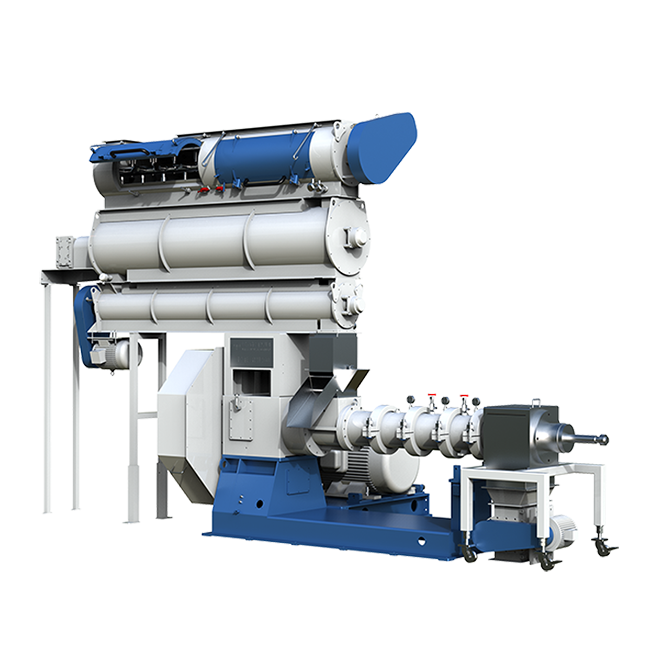
FAMSUN offers SXPS, SJPZ, and SJPX series extruders for pig, poultry, ruminant, and aquafeed applications. These systems are designed around extrusion processing requirements associated with issues such as insufficient gelatinization and excessive powder content found in some conventional pelleting processes. Their relevance lies in process flexibility rather than simply equipment capacity.
Matching Process Conditions To The Formula
Successful grain processing begins with understanding what each ingredient contributes to the formulation. Starch-rich corn may require attention to gelatinization, barley may call for closer control of fiber-related flow behavior, and full-fat soy demands consideration of oil content and anti-nutritional factors. Moisture adjustment can influence all three, while screw speed and die resistance affect the mechanical and thermal environment.
An extruder machine performs best when these variables are evaluated as an interconnected system. Changes in raw-material moisture can alter pressure; modifying feed rate can affect residence time; and changing screw speed can influence mechanical energy. Process control becomes a matter of balancing ingredient characteristics with the desired nutritional and physical outcome.
Conclusion
Grain extrusion transforms feed ingredients through a combination of thermal energy, moisture, pressure, and mechanical action. Corn benefits from controlled starch gelatinization, barley requires attention to fiber-related processing behavior, and full-fat soy needs sufficient heat to reduce anti-nutritional factors while protecting its nutritional value. Proper extrusion in food processing depends on the right balance between those ingredient characteristics with suitable operating conditions rather than relying on temperature alone. With technologies such as the SXPS, SJPZ, and SJPX series, FAMSUN addresses multiple feed applications where improved gelatinization, reduced powder content, and more controlled processing are important considerations.