
A public ev charging station at a municipal park-and-ride facility may serve commuter cars, weekend visitors, and electric shuttles during the same operating day. Those users have different dwell times and energy needs. Planning decides where AC charging is sufficient, where DC charging is necessary, and how both can share limited site capacity without reducing access for other users.
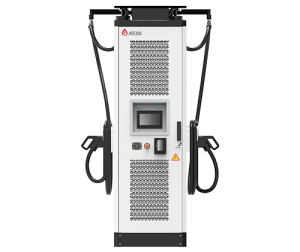
ATESS describes charging equipment for public, commercial, and residential applications, including AC, DC, and combined configurations. They support connector standards such as CCS1/Type 1, CCS2/Type 2, CHAdeMO, GB/T, and NACS, allowing public-site planners to match vehicle populations, charging power, parking behavior, output structure, and daily access requirements.
How Public Charging Stations Deliver Energy to Vehicles
AC charging sends alternating current from the station to the vehicle’s onboard charger. That onboard unit converts AC into DC for the battery, so the vehicle determines part of the final charging rate. Station output, onboard-charger capacity, battery state, and parking duration therefore work together. A higher-rated AC station cannot force a vehicle to accept more current than its charger allows.
DC charging performs AC-to-DC conversion inside the station and sends controlled DC directly to the vehicle battery. The charger communicates with the vehicle to negotiate voltage and current, then adjusts output as battery conditions change. This path supports higher power and shorter visits, but it also creates greater thermal, protection, cable, and transformer requirements at the public site.
A combined station adds one AC output and two DC outputs within one installation. The energy path remains separate for each vehicle, but the site shares space, electrical supply, communications, and maintenance resources. This arrangement can serve a commuter car parked for hours and an electric shuttle needing rapid replenishment without requiring completely separate charging areas.
What Changes Between AC, DC, and Combined Charging?
AC charging fits vehicles that remain parked for several hours. Commuters may connect during a workday, while visitors may charge during a long appointment or shopping period. Moderate power can provide useful energy without creating the same peak demand as a high-power DC installation. Multiple AC spaces may also serve more vehicles when parking turnover is predictable.
DC charging fits shorter dwell times and higher daily throughput. An electric shuttle returning between routes may need substantial energy before its next departure, while a public user may not remain parked long enough for moderate AC charging. DC equipment reduces dependence on the vehicle’s onboard charger, but the station and site must support higher current and heat.
Combined charging fits public sites with mixed behavior. AC can serve long-stay passenger vehicles, while two DC outputs serve shuttles, taxis, or visitors requiring faster turnaround. The benefit is shared infrastructure, not unlimited capacity. Power sharing, connector access, parking controls, and queue management still determine whether the combined arrangement improves actual service.
The Variables That Shape Public Station Selection
Vehicle dwell time is the first variable. A commuter car parked for eight hours can use moderate AC power, while a shuttle leaving after twenty minutes needs higher-power DC charging. Required energy per visit matters as well. A vehicle arriving with a partially charged battery may need less energy than one completing repeated routes across the day.
Site capacity sets the next boundary. Transformer size, service voltage, feeder length, demand charges, and simultaneous building loads determine how much charging power can be added. Load management can distribute available power among AC and DC outputs, but it cannot create additional grid supply. Public lighting, security systems, and nearby facilities must remain within the same electrical plan.
Connector standards and operating controls affect usability. CCS1/Type 1, CCS2/Type 2, CHAdeMO, GB/T, and NACS support different vehicle populations. Single and dual outputs change how power is shared, while networking, payment, fault monitoring, temperature control, cable reach, and maintenance access influence whether the station remains available after installation.
ATESS Combo EV Charging Stations for Public Sites
For a municipal park-and-ride facility serving commuters, visitors, and electric shuttles, the public ev charging station family includes EVC-AC22S/DC200D-X and EVC-AC44S/DC200D-X combo models. Each combines one AC charging output with two DC charging outputs, allowing long-stay passenger vehicles and higher-throughput users to share one public installation while following different dwell-time requirements during the same operating day.
The three-output structure separates the charging paths while coordinating them within the same site equipment. AC service can support vehicles parked for several hours, while DC outputs can provide faster replenishment for shuttles or short-stay users. The practical result depends on transformer capacity, connector population, cable routing, control software, payment functions, and how available power is shared between simultaneous sessions.
The product choice should follow the public-site user mix. A mostly commuter facility may favor more AC capacity, a shuttle-oriented site may need greater DC power, and a mixed park-and-ride location may benefit from the combo structure. The station still requires vehicle-compatibility checks, protection design, payment planning, parking control, networking, and maintenance access.
The Selection Rule for Public Charging Infrastructure
Select AC when vehicles remain parked for hours and moderate power can meet energy needs. Select DC when vehicles require rapid turnaround and the site can support higher electrical and thermal demand. Select combined equipment when one public location must serve both long-stay passenger vehicles and higher-throughput vehicles without creating separate charging zones or duplicating site infrastructure.
ATESS charging equipment can support mixed public users, but it does not create grid capacity, eliminate transformer upgrades, guarantee every connector’s compatibility, or replace parking, payment, networking, and maintenance planning. The suitable public charging arrangement is the one whose outputs, power levels, connectors, and operating schedule match the users sharing the site and its available electrical service.
Power cabinets, dual-output dispensers, payment, networking and load management are supplied and commissioned as one platform rather than assembled from separate brands.